Can AI Really Help Your ADHD? Practical Management Strategies for an "External Brain"

Have you ever walked into a room with a very specific mission, only to realize your brain just... uninstalled its operating system mid-stride? If you’re nodding your head, we deeply and genuinely understand. Living with ADHD often feels like having a Ferrari engine for a brain but with bicycle brakes: or worse, a GPS that keeps recalculating while you’re already doing 70 mph on the freeway.
At NICE Mindset, we believe that being neurodivergent isn’t a "bug" in the human code; it’s a different kind of operating system. But let's be real: the world is built for the "standard" version, which is why we’re always looking for ways to bridge that gap. Recently, there’s been a lot of buzz about Artificial Intelligence (AI). Is it just another shiny distraction to get lost in, or could it actually be the "External Brain" we’ve been waiting for?
Spoiler alert: When used thoughtfully and carefully, AI can be an absolute game-changer for ADHD management strategies. Let’s dive into how we can leverage these tools to support our executive functions without spiraling into a 4-hour rabbit hole of "optimizing" a digital dashboard we’ll never look at again.
Why We Need an "External Brain"
For many of us, the struggle isn't a lack of intelligence or drive; it’s the "middle man" of executive function. This includes things like working memory, emotional regulation, and: the ultimate boss battle: task initiation. When we talk about executive function coaching, we’re usually looking for ways to outsource the heavy lifting that our internal prefrontal cortex finds exhausting.
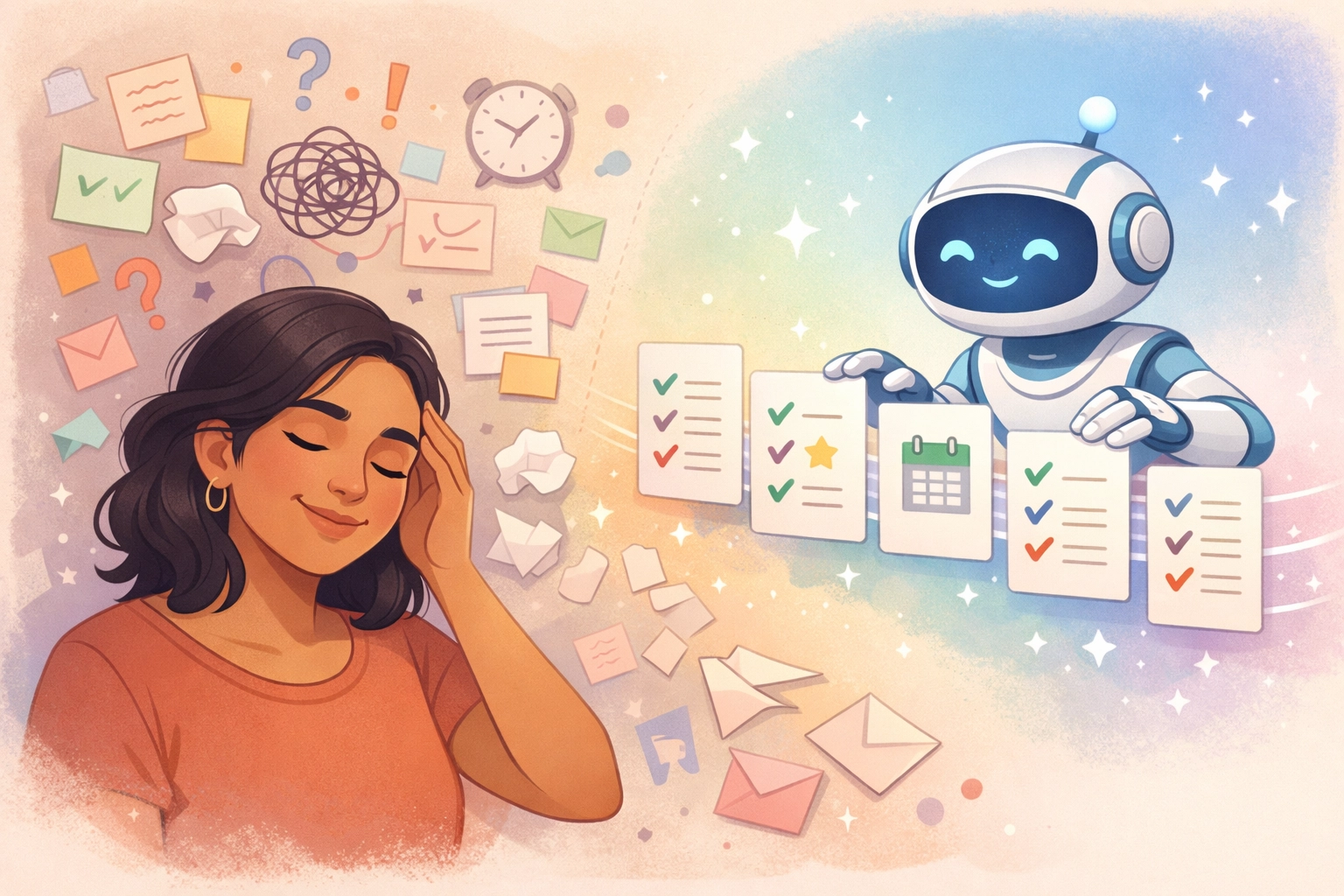
Research is actually backing this up in some pretty incredible ways. Recent studies have shown that machine learning models can analyze neurophysiological data, like EEG signals, with up to 98.21% accuracy in identifying ADHD patterns. This means technology is finally beginning to "see" us with the clarity we’ve always deserved. If AI can help doctors understand our brains better, it can certainly help us navigate our daily lives with a bit more grace and a lot less "ADHD tax."
1. Defeating the "Blank Page" Paralysis
One of the biggest hurdles for neurodivergent adults is the "cold start." Whether it’s writing an email, starting a project, or even deciding what’s for dinner, the sheer number of choices can lead to total paralysis.
This is where AI like ChatGPT or Claude becomes your "Co-Pilot." Instead of staring at a blinking cursor, you can give it a messy, disorganized brain dump.
The Strategy: Tell the AI: "I need to write an email to my boss asking for a deadline extension because I'm overwhelmed, but I want to sound professional and not like I'm panicking. Here are some bullet points of what happened..."
Why it works: It handles the "translation" from your internal chaos to professional output. We find that once a draft exists, it’s much easier for our clients to edit it than to create it from scratch. It’s about lowering the barrier to entry for your brain.
2. Breaking Down the "Wall of Awful"
You know that one task? The one that’s been on your to-do list for three weeks? It’s not just a task anymore; it’s a monument to your perceived failures. We call this the "Wall of Awful."
AI is incredibly good at "chunking." You can take a massive, scary project like "Clean the Garage" and ask an AI to break it down into 10-minute micro-tasks.
The Strategy:"I need to clean my garage. I am feeling very overwhelmed. Give me five 10-minute tasks I can do today that will make a visible difference."
The Win: By outsourcing the planning phase, you save your precious executive function "spoons" for the actual doing.

3. Real-Time Monitoring and Personalization
We live in an era where AI isn't just about chatbots; it’s about wearable tech and personalized data. For those of us exploring medication or specific lifestyle changes, AI is becoming a powerful ally in ADHD management strategies.
Algorithms can now analyze clinical history and genetic profiles to help predict which medications might work best for a specific individual, minimizing the "trial and error" phase that can be so draining. At NICE Mindset, we believe that having this kind of data is empowering. It moves the conversation from "Why can't I just do this?" to "Here is how my specific biology responds to this intervention."
If you're looking for deeper insights into your own unique path, our Services are designed to help you integrate these high-tech tools with high-touch human support.
4. The "External Memory" Vault
One of the core components of our executive function coaching is finding ways to stop relying on our internal working memory. Our working memory is like a whiteboard that gets wiped clean every time someone walks past it.
Tools like Notion (which now has integrated AI) or Mem allow you to create a searchable "second brain."
The Strategy: Use AI-powered search to find that one note you wrote six months ago. Instead of remembering where you put the information, you only need to remember that the information exists.
Thoughtful Tip: Use voice-to-text AI tools to capture ideas while you're driving or walking. Don't wait until you're at a desk; the idea will be gone by then! We truly value the brilliance of your spontaneous thoughts, and we want to help you catch them before they float away.

5. Avoiding the "AI Productivity Trap"
We would be remiss if we didn't mention the "shiny object" syndrome. For a neurodivergent person, a new AI tool can be like a brand-new playground. You might spend six hours "setting up" your AI automations and zero hours actually doing your work. We've all been there, and we've all felt that sting of regret.
How to stay safe:
Set a Timer: Give yourself 20 minutes to play with a tool. When the timer goes off, you’re done for the day.
Focus on Utility, Not Aesthetics: It doesn't need to look pretty. It just needs to work.
One Tool at a Time: Don't try to overhaul your whole life with five different AI apps at once. Start with one simple use case, like using AI to summarize long articles or draft emails.
AI + Human Connection: The Ultimate Power Couple
While AI is an incredible tool for the "mechanics" of life, it can’t replace the warmth, empathy, and shared journey of human coaching. AI can tell you how to break down a task, but it can’t sit with you in the frustration of a hard day or celebrate the genuine joy of your wins.
At NICE Mindset, we view AI as a supportive assistant in our shared journey toward your thriving. We carefully and thoughtfully integrate these modern strategies with a compassionate approach that recognizes your inherent value. We don't just want you to be "productive": we want you to feel understood, supported, and cherished for exactly who you are.
If you’re feeling overwhelmed by the possibilities and want a clear, insightful path forward, we’d love to connect. Whether you're interested in ADHD coaching or simply need a safe space to explore your neurodivergent identity, we are here for you.
Taking the Next Step
Using AI as an external brain is a journey of self-discovery. It’s about learning how you think and finding the "assistive tech" that fits your lifestyle. Remember, there is no "right" way to manage your brain: there is only the way that works for you.
If you’re ready to stop fighting your brain and start supporting it with expert guidance and a compassionate community, we invite you to take a positive step toward your well-being.
Explore our Membership for ongoing support and resources.
Schedule a consultation here to discuss a personalized coaching plan.
Check out our Reviews to see how others have found their clarity and peace.
We are so incredibly honored to be part of your story. Together, we can turn the chaos into a clear, vibrant path toward a brighter tomorrow. Let's start building that external brain, one thoughtful prompt at a time. 🚀✨