The 'Missing Homework' Mystery: Why Traditional Organization Doesn't Work for Neurodivergent Kids

Updated: Mar 28
It’s 8:00 PM on a Tuesday. You’ve just finished a long day, and all you want to do is curl up with a book or catch up on your favorite show. But then, the dreaded question arises: "Where is your math worksheet?"
Your child looks at you with a mix of confusion and genuine distress. They know they did it. They remember the scratch of the pencil on the paper. They might even remember tucking it away. But as you both dive into the "black hole" that is their backpack: sifting through crumpled permission slips, three-week-old granola bar wrappers, and a stray sock: the worksheet is nowhere to be found.
At NICE Mindset, we’ve sat at many kitchen tables (literally and figuratively) alongside families facing this exact mystery. It’s exhausting, it’s frustrating, and it often leads to tears for both parent and child. If you’ve ever felt like you’re failing as a parent because your child can’t seem to keep track of a single piece of paper, we want to stop you right there.
You aren't failing, and your child isn't being "lazy" or "defiant." The truth is simply this: traditional organization systems were designed for neurotypical brains, and they often fail our beautiful, complex, neurodivergent kids.
The "Planner and Folder" Fallacy
When a student struggles with organization, the school’s first recommendation is almost always a planner. "Just write it down!" they say. "Put it in the blue folder!" they suggest.
While well-intentioned, this is like telling someone who is nearsighted to "just look harder" without giving them glasses. Traditional planners and folders require a high level of executive functioning: the brain’s "CEO" skills that manage planning, working memory, and task initiation. For kids with ADHD or those on the autism spectrum, these skills aren't always online in the same way.

(Description: A diverse teenager sitting on a cozy bedroom floor, leaning against a bed, surrounded by a few colorful notebooks and a laptop. They look relaxed rather than stressed, representing a non-traditional but effective study space.)
When we provide neurodiversity support, we explain that a planner actually requires a student to:
Remember to bring the planner to class.
Listen to the teacher while simultaneously writing.
Process the instructions and condense them into a short note.
Remember to bring the planner home.
Actually open the planner at home.
That’s five separate executive function hurdles before the homework even starts! It’s no wonder the system breaks down. Through our executive function coaching, we work to build systems that work with a child's brain, not against it.
The Transition Trap: Moving from "Fun" to "School"
One of the most heart-wrenching parts of the "Missing Homework Mystery" isn't just the lost paper: it’s the battle to get the work started in the first place. For neurodivergent kids, transitions are incredibly taxing.
Think about the "Wall of Awful." This is a term coined by ADHD advocates to describe the emotional barrier of shame, failure, and anxiety that builds up around a task that has been difficult in the past. Moving from a high-dopamine activity (like Minecraft or drawing) to a low-dopamine activity (like long division) feels physically painful for an ADHD brain.
We deeply understand this struggle. It’s not a lack of willpower; it’s a neurobiological challenge. When we offer ADHD coaching, we help parents and kids create "on-ramps" for these transitions. Instead of a sudden "Stop and do your homework," we look at ways to gently bridge the gap, respecting the child's need for regulation and autonomy.

The "Just Right" Environment and the ADHD Sleep Hands
Have you ever noticed your child doing something seemingly "weird" while they try to focus? Maybe they need to lie upside down on the couch to read. Maybe they need loud music playing to drown out the silence. Or maybe you've seen the "ADHD sleep hands": where they curl their wrists in like a little T-Rex when they are relaxing or concentrating.
These aren't "bad habits." They are often self-regulation strategies. Neurodivergent kids often need a "just right" sensory environment to allow their brains to engage with "un-fun" tasks.
The "T-Rex" Hands: Often a sign of comfort and physical regulation.
Fidgeting: Movement actually helps the ADHD brain produce the dopamine it needs to stay alert.
Body Doubling: Sometimes, just having you sit in the room (not helping, just being there) provides the "anchor" they need to stay on task.
When we provide neuropsychology support, we encourage parents to embrace these quirks. If the homework gets done while they are sitting under the dining room table with a flashlight, does it really matter that they aren't at a desk?
Why "Invisible" Systems Fail
The core issue with folders and planners is that they make information invisible. Once that worksheet is inside a blue folder, which is inside a backpack, which is in the hallway... it effectively ceases to exist in the mind of a child with working memory challenges.
To solve the mystery, we have to externalize the information. We need to make the invisible, visible.
Strategies That Actually Stick:
The "Launchpad": A dedicated, visible spot by the door where everything: backpack, shoes, sports gear: lives. If it’s not on the launchpad, it doesn't exist.
Visual Timers: Using a clock that shows time "disappearing" (like a red disk getting smaller) helps kids with time blindness understand how much time they actually have.
Clear Totes over Folders: Sometimes, seeing the papers through a clear plastic sleeve is enough to remind the brain that the work is there.
The "Done" List: Instead of just a "To-Do" list, celebrate the "Done" list to provide that much-needed hit of dopamine.
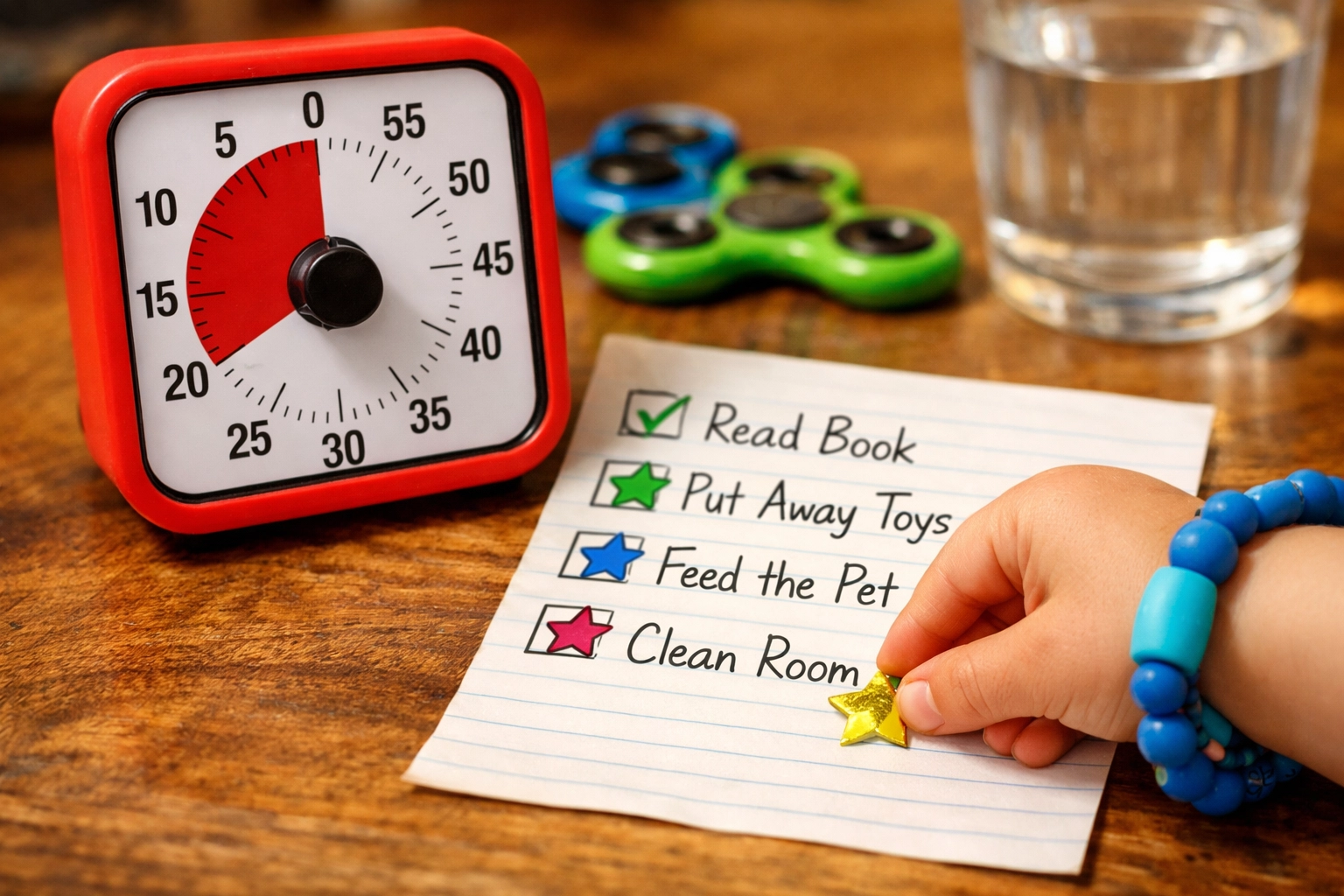
(Description: A close-up of a visual timer on a wooden table next to a simple, hand-drawn checklist with colorful checkmarks, showing a clear and supportive way to manage tasks.)